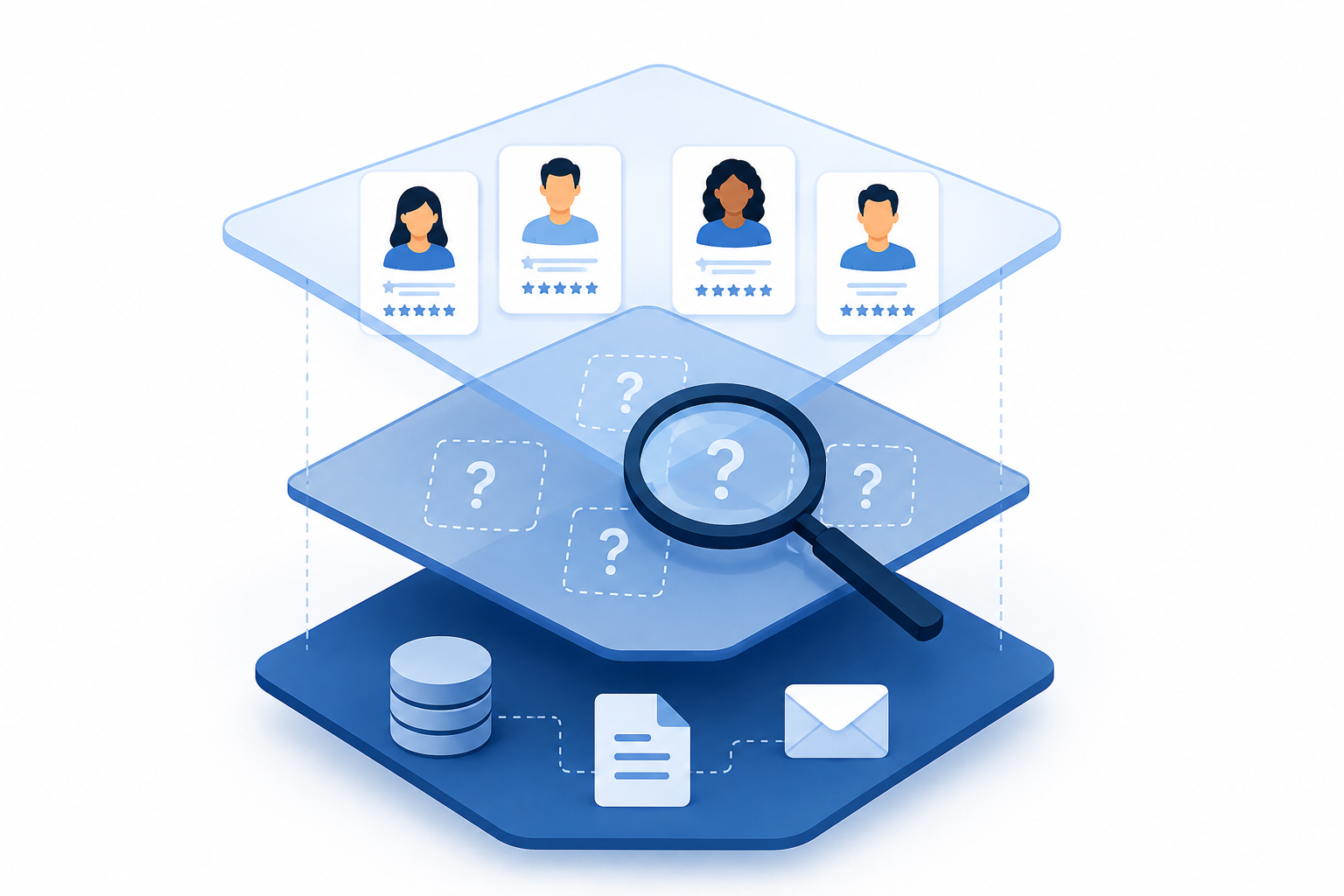
The staffing industry has never had more software. There's an ATS for tracking, a CRM for relationships, sourcing tools, scheduling tools, assessment tools, and an AI layer bolted onto most of them. Yet the core problem — quickly and confidently knowing which people can do which jobs — hasn't been solved. More tools kept getting added on top of the same weak foundation. The thing actually missing isn't another app. It's a data layer.
Every mature software category eventually develops one: a structured, shared source of truth that applications draw from instead of each maintaining its own private, half-accurate copy. Staffing skipped that step. It went straight to buying interfaces while leaving the underlying talent data unstructured, unverified, and scattered. This article is about that gap and what it costs.
Tools are not infrastructure
A tool helps you do a task. Infrastructure is what every tool relies on to work at all. When staffing firms say they've "invested in technology," they usually mean tools — a shinier way to move candidates through the same pipeline. The data those tools run on is still raw resume text and self-reported claims, so each tool inherits the same blind spots. You can automate a broken process, but you can't automate your way out of not knowing what your data means.
What the missing layer would actually hold
A real talent data ecosystem stores far more than contact details and a resume. It captures verified capability, seniority signals, domain experience, assessment results, and behavioral evidence — all structured into defined fields and kept current. That's the layer staffing never built, and its absence is why sourcing still feels like manual archaeology through a pile of documents.
Signals a resume can't carry
• Whether a claimed skill is actually demonstrated, not just listed.
• How a candidate performed in a real assessment or work sample.
• Seniority and scope inferred from evidence rather than an inflated title.
• Whether any of it is still true today, or quietly decayed months ago.
None of that fits in a resume, and none of it survives in a note field. Without a data layer to hold it, the most valuable signals in recruiting are lost the moment they're observed.
Why the gap persists
The gap survives because it's invisible on a good day. When placements are flowing, nobody audits the foundation. It shows up as symptoms instead: searches that miss obvious candidates, re-screening people you already vetted, clients who don't trust your shortlist, and databases so noisy they're effectively write-only. Firms treat each symptom with another tool, which adds cost without touching the cause.
What filling the gap unlocks
Fill the layer and the whole stack gets sharper, because every tool is now drawing on structured, verified data instead of raw text. This is the model Simera is built on: a data engine that captures first-party, permissioned candidate data — video, audio, verifications — verifies and scores it, and refreshes it continuously so roughly 77% of its content is unique and, more importantly, current. The interface matters less once the data underneath is real.
The firms that recognize this stop asking "what tool should we buy next" and start asking "what would it take to own a verified talent data ecosystem." That's the shift from consuming software to building infrastructure — and it's the one that separates staffing firms that scale from those that just stay busy.
Continue the series: The People Data Layer
This article is part of Simera's 8-part series on the people data layer. Keep reading with Every Staffing Company Needs a People Data Layer, Staffing Needs Data Infrastructure, From ATS Database to Talent Intelligence, Your Candidate Database Is an Untapped Data Asset, The API-fication of Talent, People Data Lessons From Fintech, and Portable, Structured, Interoperable Talent Data.
📊 The data layer, in one place.
Frequently asked questions
What does "missing data layer" mean in staffing?
It means the industry has plenty of tools but no shared, structured, verified source of truth for talent data. Each tool runs on raw resumes and self-reported claims, so none of them can reliably answer who can do a given job.
Isn't our ATS the data layer?
No. An ATS stores records and manages workflow, but it doesn't verify, score, or structure the underlying data. A data layer is the intelligence foundation your ATS and other tools should draw from.
Why hasn't staffing solved this already?
Because the gap is invisible when placements flow. Firms treat the symptoms — missed candidates, re-screening, low client trust — by buying more tools, which never fixes the unstructured data underneath.
What changes once the layer exists?
Every tool gets sharper because it's running on verified, structured, current data. Search improves, shortlists earn client trust, and you stop re-vetting people you already evaluated.