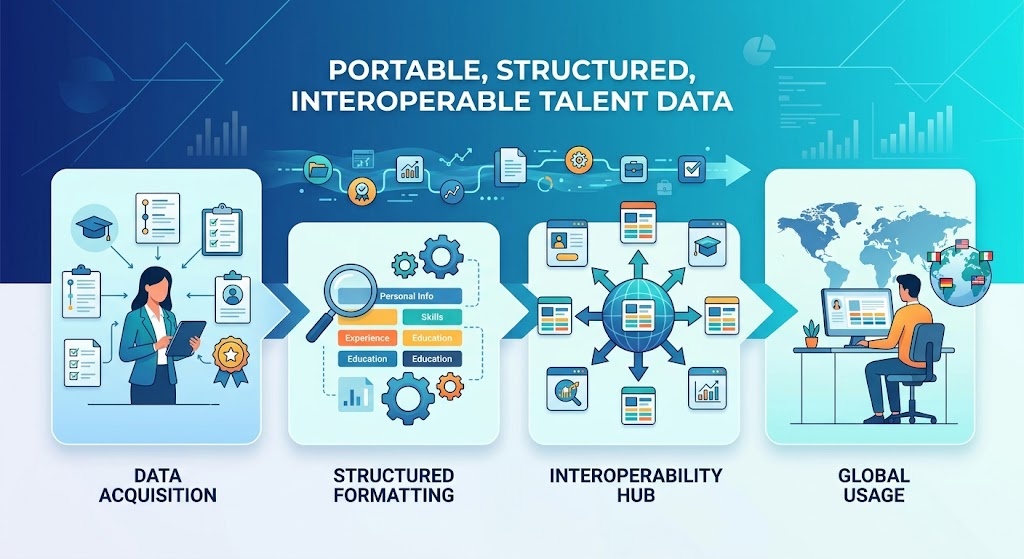
Most talent data today is the opposite of what it should be: trapped in one tool, stored as unstructured text, and unable to talk to anything else. A candidate's real value — their verified capability, their history with you, their fit for future roles — is locked inside a resume attachment in an ATS that speaks only its own dialect. Three properties would change that entirely: portability, structure, and interoperability. Together they're becoming the standard staffing is moving toward, and firms that adopt them early will compound an advantage.
These aren't abstract data-governance ideals. Each property directly determines how much your talent data is worth and how much work it can do. This article breaks down all three and why the absence of any one of them quietly caps the value of everything you've collected.
Structured: data you can actually query
Structure means capability, seniority, domain, and evidence live in defined fields rather than buried in prose. Structured data is queryable, comparable, and machine-readable; unstructured data is a document a human has to read. The moment candidate signals are structured, you can ask precise questions and get precise answers — and every tool on top of the data gets sharper. Without structure, even the best search is guessing at meaning inside free text.
Portable: data that isn't held hostage
Portability means your talent data can move — between tools, through migrations, and into whatever you build next — without being trapped in a proprietary format. Data locked to a single vendor is a liability disguised as a feature: it makes you switch-averse and caps what you can do with your own information. Portable data keeps the leverage with you, the owner, not the tool. It's the difference between renting access to your data and actually owning it.
Interoperable: data that works with everything else
Interoperability means different systems can read and use the same data without custom translation for every pairing. It's what lets a structured, portable dataset actually flow through your stack instead of stalling at each integration. Interoperable talent data is what makes composable products possible — the same shift that let other industries build ecosystems once their core data spoke a shared language.
Why all three have to travel together
• Structured but not portable — powerful data you can't move or fully own.
• Portable but not structured — you can move it, but it's still unreadable text.
• Structured and portable but not interoperable — good data that still can't plug into your other systems.
• All three together — data that is queryable, owned, and usable everywhere: a genuine asset.
Building to the standard
This standard is exactly what a modern people data layer is designed to deliver, and it's how Simera's data engine is built: first-party, permissioned candidate data captured as structured, multi-modal, verified signals, held in a form that's meant to be refreshed and reused rather than locked away. Roughly 77% of that content is unique to Simera, and because it's structured and verified at the source, it's the kind of data that can be portable and interoperable without losing its meaning.
For any firm, the practical move is to set the standard now: insist that new talent data is captured structured, kept portable, and made interoperable. Every record collected to that standard compounds in value; every record collected the old way starts decaying inside a silo the moment it's created.
Continue the series: The People Data Layer
This article is part of Simera's 8-part series on the people data layer. Keep reading with Every Staffing Company Needs a People Data Layer, The Missing Data Layer in Staffing, Staffing Needs Data Infrastructure, From ATS Database to Talent Intelligence, Your Candidate Database Is an Untapped Data Asset, The API-fication of Talent, and People Data Lessons From Fintech.
📊 The data layer, in one place.
Frequently asked questions
What does portable talent data mean?
It means your candidate data can move between tools and migrations without being trapped in one vendor's proprietary format — so you own and control it rather than renting access to your own information.
Why does structure matter so much?
Structured data — capability and evidence in defined fields — is queryable, comparable, and machine-readable. Unstructured resumes force every tool to guess at meaning inside free text, which caps accuracy.
What is interoperability in talent data?
It's the ability for different systems to read and use the same data without custom translation for every integration, letting structured, portable data actually flow through your whole stack.
Do we need all three properties?
Yes. Missing any one caps the value: unportable data can't be owned, unstructured data can't be queried, and non-interoperable data can't plug into your systems. Together they make data a real asset.