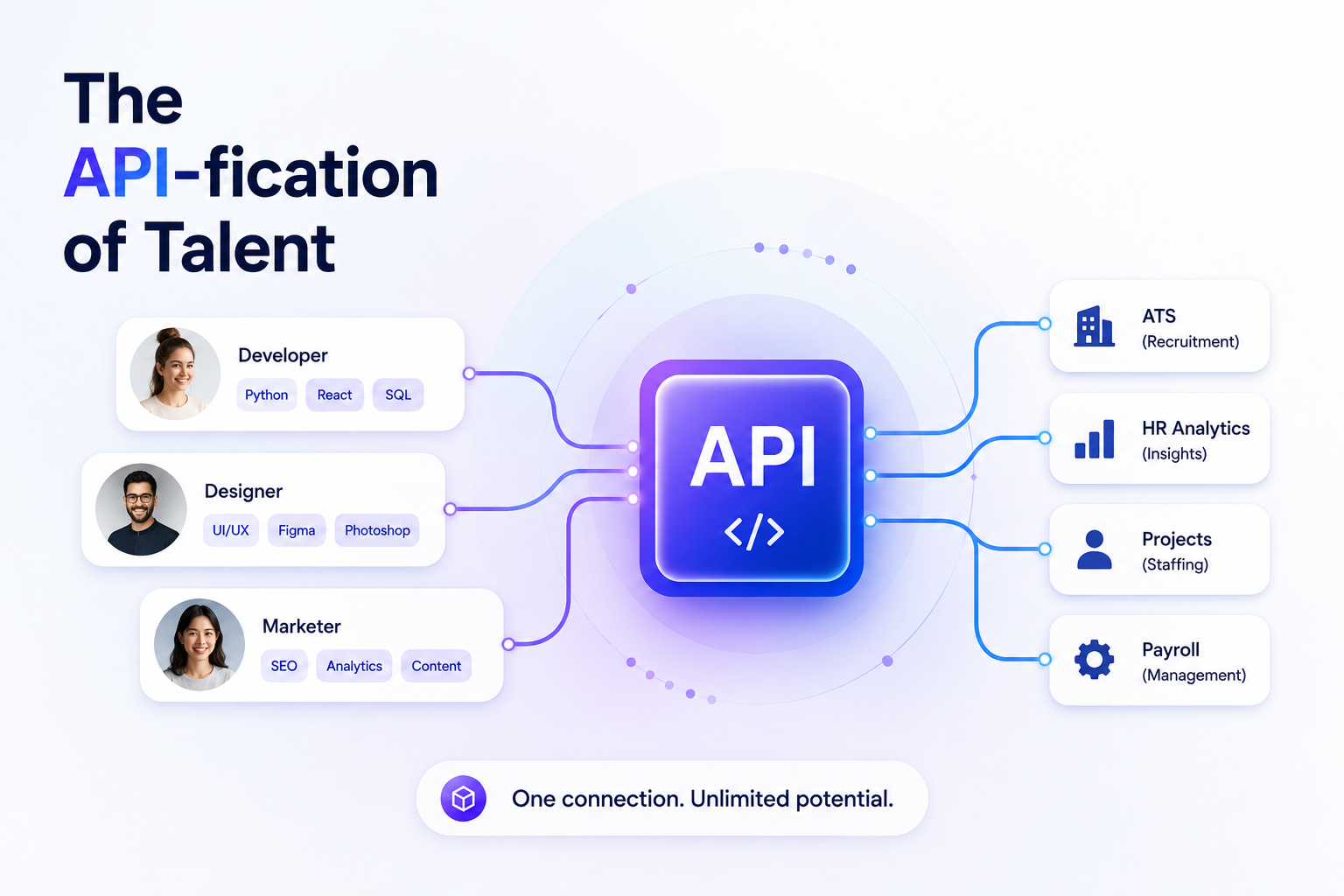
Every industry that got transformed by software went through the same quiet revolution: its core resource became programmable. Payments became an API. Maps became an API. Compute became an API. Once something turns into structured, callable infrastructure, a wave of new products gets built on top of it that were impossible before. Talent is next — and the shift has a name worth using plainly: the API-fication of talent.
For staffing, this is more than a technical curiosity. When talent data becomes structured, verified, and programmatically accessible, the entire model of how firms find, match, and deliver people changes. This article lays out what API-fication means for talent and why the firms treating talent data as infrastructure will define the next generation of the industry.
What API-fication actually means
To API-fy something is to turn it from a manual, bespoke process into structured infrastructure that other systems can query on demand. Before payment APIs, accepting a card meant custom bank integrations; after, it was a few lines of code. The resource didn't change — its accessibility did. API-fying talent means turning candidate data from unstructured resumes and manual review into verified, structured signals any system can call and reason over.
Why talent has resisted it so far
Talent stayed manual because its raw material was messy. A resume is unstructured text; a claim is unverified; a candidate's real ability lives in a dozen signals no system captured cleanly. You can't build a reliable API on top of data that's inconsistent, unverified, and decaying. That's the real blocker — not a lack of ambition, but the absence of a structured, trustworthy data foundation underneath. Fix the foundation and API-fication follows.
The prerequisites for programmable talent data
• Structured signals — capability, seniority, and evidence in defined, machine-readable fields.
• Verification — trust built into the data so systems can rely on it without re-checking.
• Freshness — continuous updates so the data an API returns is true right now.
• Interoperability — a portable format that isn't trapped inside one vendor's walls.
What becomes possible once talent is programmable
When talent data is structured and callable, matching stops being a manual craft and becomes a capability you can compose. Role-fit analysis, comparisons and rankings, evidence-based matching, and profile scoring all become functions running against a live data layer rather than tasks a recruiter performs by hand. New products emerge — the same way fintech exploded once payments were programmable — and staffing firms shift from doing the matching to building on top of matching infrastructure.
Who builds the infrastructure
API-fication needs someone to do the unglamorous work of making talent data trustworthy first. That's exactly what Simera's data engine is: first-party, permissioned, multi-modal candidate data, verified and scored with AI, indexed by a continuously refactored search engine, and kept fresh by automated triggers. Around 77% of that data is unique to Simera, which matters enormously for an API — programmable infrastructure is only as valuable as the data behind the endpoint is unique and verified.
The staffing firms that thrive in this next phase won't be the ones with the biggest resume pile. They'll be the ones that either build on programmable talent infrastructure or become it — treating verified, structured, callable people data as the platform everything else runs on.
Continue the series: The People Data Layer
This article is part of Simera's 8-part series on the people data layer. Keep reading with Every Staffing Company Needs a People Data Layer, The Missing Data Layer in Staffing, Staffing Needs Data Infrastructure, From ATS Database to Talent Intelligence, Your Candidate Database Is an Untapped Data Asset, and Portable, Structured, Interoperable Talent Data.
📊 The data layer, in one place.
Frequently asked questions
What does "API-fication of talent" mean?
It's the shift of talent data from manual, unstructured resumes and review into verified, structured infrastructure that other systems can query programmatically — the same transformation payments and maps went through.
Why hasn't talent been API-fied already?
Because its raw material is messy: unstructured resumes, unverified claims, and decaying data. You can't build a reliable API on an untrustworthy foundation, so structured, verified data has to come first.
What becomes possible when talent is programmable?
Matching, role-fit analysis, scoring, and rankings become composable functions running against a live data layer, enabling new products — much like fintech emerged once payments became an API.
What makes a talent API valuable?
The uniqueness and verification of the data behind it. A programmable endpoint is only as good as its data; first-party, verified, proprietary data (like Simera's ~77% unique content) is what makes it worth building on.