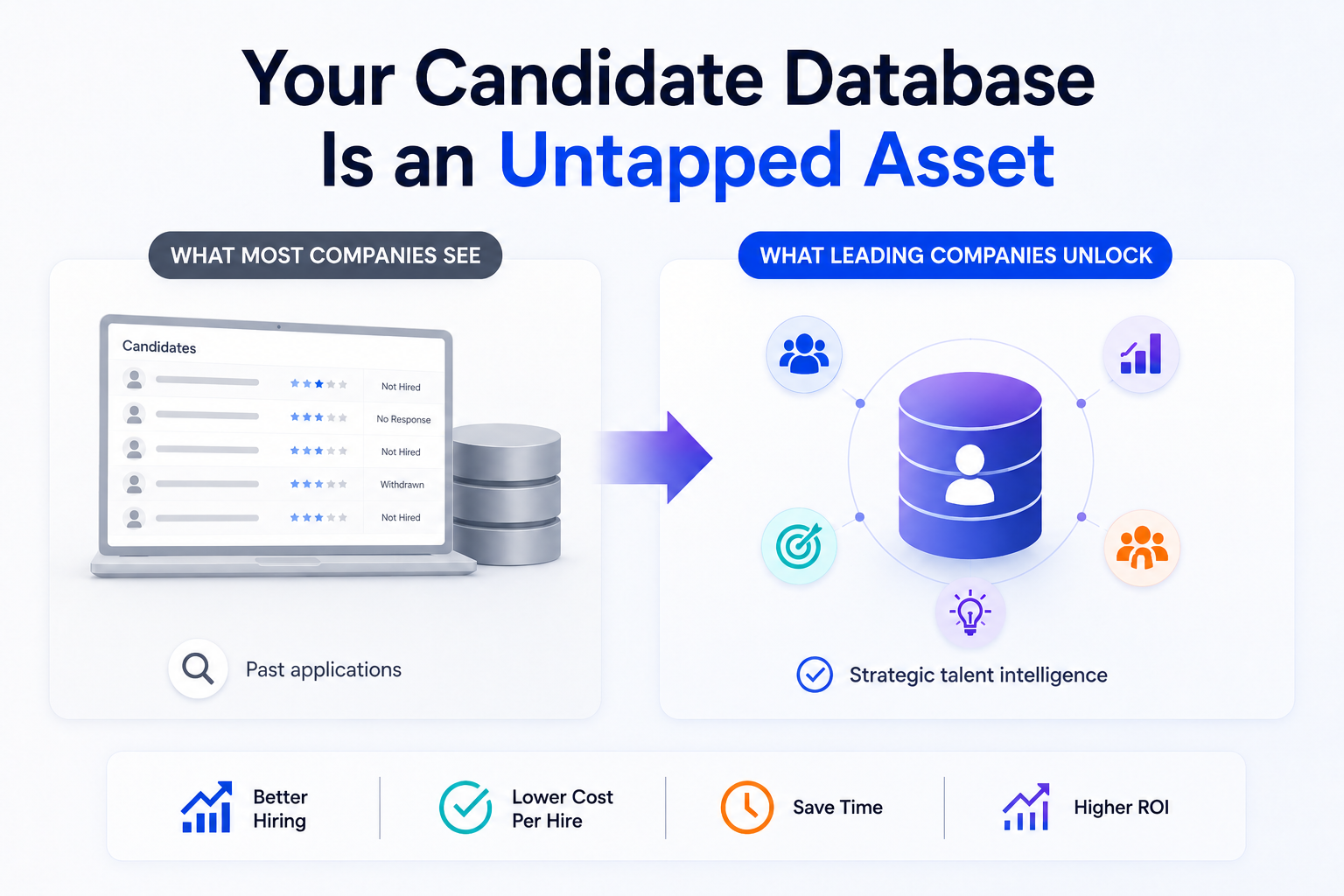
Most staffing firms describe their candidate database as a place to store people. That framing quietly caps its value. A database is storage; an asset is something that produces value over time. The same set of candidate records can be either, depending entirely on whether it's structured, verified, and put to work — and the gap between those two states is where a huge amount of latent value in staffing is trapped.
Reframing your candidate database as a data asset changes how you treat it, invest in it, and eventually monetize it. This article makes the case that the records you already own could be one of the most valuable things your firm holds — and why, for most firms, that value is currently sitting idle.
Storage vs. asset: the difference is structure
A pile of resumes is storage: it costs money to keep and returns nothing until someone manually digs through it. An asset works for you — it's queryable, it compounds, and it gets more valuable as it grows. The thing standing between the two is structure and verification. Unstructured, unverified records are a liability with a hosting bill. Structured, verified records are a moat.
Why unstructured data quietly loses value
Every candidate record starts decaying the moment it's created. Roles change, skills grow, contact details break, and self-reported claims were never verified to begin with. Left alone, a database doesn't hold steady — it degrades. That's why firms are often shocked at how little of their "huge database" is actually actionable: most of it decayed while being treated as inert storage rather than a living asset that needs upkeep.
What turns records into an asset
• Verification — claims backed by assessments and checks, so the data can be trusted and acted on.
• Structure — capability and evidence in defined fields, so the data is queryable and comparable.
• Freshness — continuous updates, so value accrues instead of decaying.
• Reusability — the same data powers many searches and clients, compounding its return.
The proprietary-data moat
Here's the part most firms miss: the most valuable candidate data is the data nobody else has. Anyone can scrape public profiles — that's a commodity, shallow and shared by every competitor. First-party data captured directly through your own relationships is unique, and unique data is defensible. Simera built its whole model on this: roughly 77% of its content is completely unique to Simera because it's generated through direct candidate touchpoints and automated collection, not scraped from the web. That proprietary data is the moat; the scraped stuff is just cost.
How to start treating it like an asset
Begin by refusing to let the database sit inert. Capture first-party signals directly, verify them, structure them into comparable fields, and keep them refreshed — the same flywheel that keeps any real people data asset alive. Simera's data engine automates that loop with zero-cost refresh triggers, but the principle applies at any scale: an asset is something you maintain and compound, not something you store and forget.
Once you see the database as an asset, the questions change. You stop asking "how many candidates do we have" and start asking "how much of our data is unique, verified, and current" — because that, not raw volume, is what the asset is actually worth.
📊 The data layer, in one place.
Continue the series: The People Data Layer
This article is part of Simera's 8-part series on the people data layer. Keep reading with Every Staffing Company Needs a People Data Layer, The Missing Data Layer in Staffing, Staffing Needs Data Infrastructure, From ATS Database to Talent Intelligence, The API-fication of Talent, People Data Lessons From Fintech, and Portable, Structured, Interoperable Talent Data.
Frequently asked questions
Why call a candidate database an "asset"?
Because structured, verified candidate data produces value over time — it can be queried, reused across clients, and compounded — whereas raw storage just costs money until someone manually digs through it.
Why does our database feel less useful than its size suggests?
Because unstructured, unverified records decay. Most of a large database quietly becomes inaccurate over time, so only a fraction is actually actionable unless it's verified and refreshed.
What makes candidate data valuable and defensible?
Uniqueness. Scraped public data is a shared commodity; first-party data captured through your own relationships is proprietary and can't be duplicated — which is why it forms a real competitive moat.
How do we keep the asset from decaying?
Maintain it like an asset: capture first-party signals, verify and score them, structure them, and refresh continuously. Automated refresh triggers keep the data current at near-zero marginal cost.