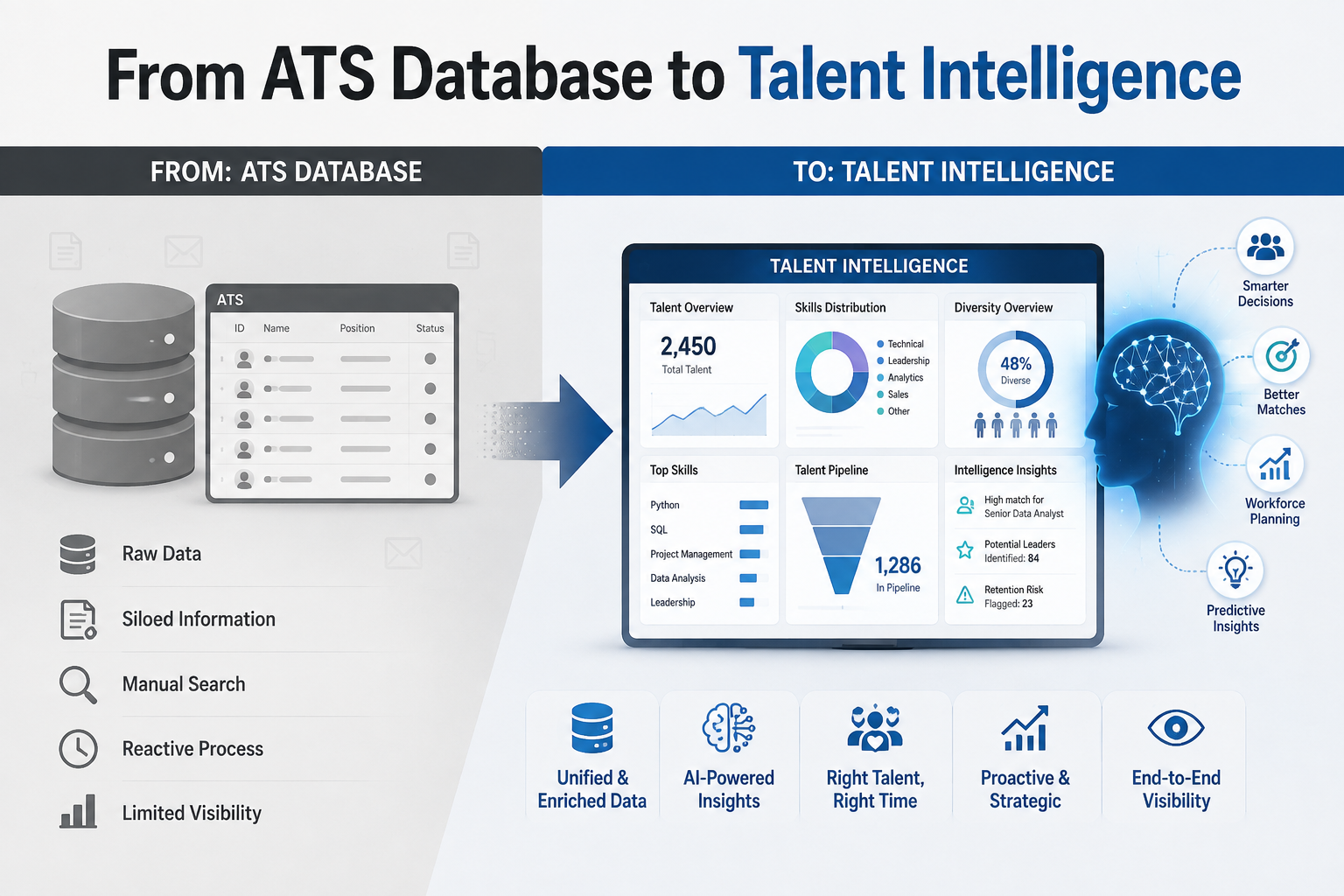
Most staffing firms are sitting on a goldmine they treat like a landfill. The ATS holds years of candidates — people you sourced, screened, interviewed, sometimes placed — and almost none of that accumulated knowledge is reused. Each new search starts from scratch, as if the thousands of people already in your system don't exist. The data is there. What's missing is the intelligence layer that would make it usable.
The move from an ATS database to talent intelligence isn't about ripping anything out. It's about changing what the data does — from a passive archive you occasionally keyword-search to an active asset you can query, score, and trust. This article walks through what that transformation involves and why it's the highest-leverage upgrade most firms aren't making.
Why the ATS became a graveyard
An ATS is designed to move a candidate through a req and keep a compliant record of it. Once the req closes, the candidate goes quiet in the system — a static row of stale fields and an attached resume. There's no mechanism to keep them current, no structured record of what you actually learned about them, and no easy way to resurface them for the next relevant role. So firms re-source people they already know, paying twice for talent they already have.
What "talent intelligence" actually adds
Talent intelligence is the difference between storing a candidate and understanding one. It layers structure, verification, and scoring onto records so you can ask real questions — not "who has these keywords" but "who in our network can actually do this job, and how confident are we." It turns the ATS from a system of record into a system of insight.
Three shifts that define the transition
• From documents to fields — capability, seniority, and domain become structured data, not prose locked in a resume.
• From claims to evidence — records carry verified signals and scores, not just self-reported bullet points.
• From static to refreshed — data is kept current so a candidate you vetted last year isn't a mystery today.
Make those three shifts and the same database you already own becomes dramatically more valuable, without adding a single new candidate.
You already paid for this data. Use it.
Every candidate in your ATS represents money already spent — on sourcing, on recruiter time, on screening. Leaving that data passive means paying full price again every time you need someone similar. Activating it means each past interaction compounds into a smarter network. The firms that win aren't necessarily the ones with the most candidates; they're the ones whose existing candidates are structured, scored, and instantly retrievable.
How the intelligence gets built
Turning records into intelligence requires the same capabilities that define any real data foundation: first-party capture, verification and scoring, structuring, and continuous refresh. Simera's data engine does exactly this at the source — collecting permissioned, multi-modal candidate data, scoring it with AI, and running a continuously refactored search engine over it, with automated triggers that keep the data fresh instead of letting it decay into the graveyard state most ATS records fall into.
You can pursue the same principle with your own network: stop treating the ATS as storage and start treating it as an intelligence asset that deserves verification, structure, and upkeep. The candidates are already yours. The intelligence is what you've been leaving on the table.
Continue the series: The People Data Layer
This article is part of Simera's 8-part series on the people data layer. Keep reading with Every Staffing Company Needs a People Data Layer, The Missing Data Layer in Staffing, Staffing Needs Data Infrastructure, Your Candidate Database Is an Untapped Data Asset, The API-fication of Talent, People Data Lessons From Fintech, and Portable, Structured, Interoperable Talent Data.
📊 The data layer, in one place.
Frequently asked questions
What is talent intelligence?
It's the structured, verified, scored view of your candidates that lets you ask real questions of your data — who can actually do a job and how confident you are — instead of running keyword searches over static resumes.
Do we have to migrate off our ATS?
No. Talent intelligence is a layer of structure, verification, and scoring applied to the data — your ATS stays as the workflow tool while the data inside it becomes far more usable.
Why do candidates in our ATS go stale?
Because an ATS has no mechanism to keep records current after a req closes. Without continuous refresh, verified data decays and candidates become mysteries you end up re-sourcing.
How is this different from AI search on our ATS?
AI search over unverified, unstructured resumes still returns confident guesses. Talent intelligence fixes the data first — structuring and verifying it — so any search on top actually reflects capability.