
7 Essential Skills Every Indian Technical Support Engineer Needs for Global Operations
Updated July 2026
High-performing Indian Technical Support Engineers combine technical expertise, multi-channel proficiency, SLA management, and customer communication skills to keep global operations running smoothly around the clock. As more companies shift support functions to distributed teams, the bar for what "great support" looks like has risen — it's no longer just about closing tickets fast, it's about closing the right tickets fast, with the right tone, and with data to prove it.
This framework outlines 7 essential skills, along with practical evaluation methods you can use when hiring, and real-world context for why each one matters.
Skill #1: Multi-Channel Support Proficiency
Handles email, live chat, and ticketing platforms efficiently — often simultaneously, without dropping quality on any single channel.
Why it matters: A customer who starts a conversation on live chat and follows up over email expects continuity, not a repeated explanation of their issue. Engineers who can fluidly manage multiple channels reduce resolution time and prevent the "I already told your team this" frustration that tanks CSAT scores.
Real-world scenario: An engineer is mid-chat with one customer when a high-priority ticket lands in the queue from an enterprise account. Strong multi-channel proficiency means triaging without losing context on either thread — not closing one conversation abruptly to handle the other.
Evaluation Method: Request a demo of multi-channel workflow management and ticket resolution.
🚀 Book a Free Discovery Call to Hire an Indian Technical Support Engineer
Skill #2: Technical Troubleshooting
Solves software, hardware, and SaaS issues across platforms, often without a scripted playbook to fall back on.
Why it matters: Modern support stacks are messy — a single customer issue might touch a SaaS integration, a browser quirk, and a backend API limit all at once. Engineers who can isolate the actual root cause (rather than treating symptoms) prevent repeat tickets and reduce escalations to engineering teams.
Evaluation Method: Provide sample scenarios and evaluate the candidate's troubleshooting process — not just whether they land on the right answer, but how they get there.
Skill #3: SLA Compliance
Adheres to response and resolution timelines consistently, even under peak load.
Why it matters: SLA breaches are one of the fastest ways to erode enterprise client trust. It's not enough to be fast on average — consistency under pressure (product outages, holiday spikes, timezone gaps) is what separates a dependable support engineer from one who only performs well in calm conditions.
Evaluation Method: Review historical SLA adherence and escalation handling from past roles.
Skill #4: Communication & Customer Service
Clear, professional, and empathetic interaction with users — regardless of how frustrated the customer is on the other end.
Why it matters: Technical accuracy alone doesn't retain customers; tone does. A correct answer delivered poorly can still result in churn, while a well-communicated "we're working on it" can buy goodwill during outages.
Real-world scenario: A customer is upset about a billing issue caused by a technical bug. The right response addresses the emotional frustration first, then walks through the fix — rather than jumping straight into technical jargon that makes the customer feel unheard.
Evaluation Method: Simulate a support ticket or live chat scenario and evaluate tone, clarity, and problem-solving.
Skill #5: Problem-Solving & Escalation Management
Manages complex issues and escalates appropriately — knowing exactly when a problem is beyond their scope, and routing it correctly instead of guessing.
Why it matters: Over-escalating wastes engineering time; under-escalating leaves customers stuck on unresolved issues for too long. The best engineers develop judgment for exactly where that line sits.
Evaluation Method: Present a challenging ticket scenario and assess decision-making and escalation judgment.
Skill #6: Monitoring & Reporting
Tracks metrics like response time, resolution rate, and CSAT, and turns that data into decisions rather than just dashboards.
Why it matters: Support data is only useful if someone acts on it. Strong engineers flag recurring issue patterns to product teams, spot early warning signs of SLA risk, and use their own metrics to improve — not just report them upward.
Evaluation Method: Request a sample report or dashboard with KPI tracking and actionable insights.
Skill #7: Adaptability & Continuous Learning
Adjusts to new tools, systems, and evolving global support needs as products and processes change.
Why it matters: Support tooling and product surfaces change constantly. Engineers who can ramp up on new systems quickly — without a steep drop in quality during the transition — keep support operations resilient through product changes.
Evaluation Method: Ask about experience learning new software or adapting to updated processes.
Bringing It All Together 7-Skill Scorecard
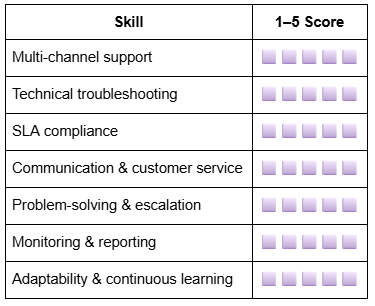
Score each candidate from 1–5 on all seven skills above. High-performing engineers typically score 28+ out of 35.
💼 Hire Pre-Vetted Indian Technical Support Engineers Today
FAQ
1. What skills are essential for Indian Technical Support Engineers?Multi-channel support, technical troubleshooting, SLA compliance, communication, escalation management, reporting, and adaptability.
2. Can they handle multiple channels simultaneously?Yes — most experienced engineers manage email, live chat, and ticketing systems concurrently without losing context between them.
3. How quickly can Simera hire a specialist?Most companies hire within 7 days of starting the process.
4. Why hire Indian engineers for global support?They combine strong technical expertise, SLA adherence, and cost efficiency, making them well-suited for round-the-clock global operations.
5. How are performance metrics tracked?Through response time, resolution rate, CSAT, and escalation management dashboards — ideally reviewed regularly rather than just at hiring time.
6. What's the biggest mistake companies make when evaluating support engineer candidates?Testing only for technical knowledge and skipping communication and escalation-judgment scenarios, which are just as predictive of on-the-job performance.
Blogs for Further Reading
https://in.indeed.com/career-advice/resumes-cover-letters/technical-support-engineer-skills
https://v3staffing.in/blog/ai-workforce-india-job-market/
https://experisindia.com/most-in-demand-tech-skills-2026-india