{ "@context": "https://schema.org", "@graph": [ { "@type": "Organization", "@id": "https://simera.io/#organization", "name": "Simera", "url": "https://simera.io/", "logo": { "@type": "ImageObject", "@id": "https://simera.io/#logo", "url": "https://simera.io/logo.png", "caption": "Simera" }, "sameAs": [ "https://www.linkedin.com/company/simera-io/" ] }, { "@type": "WebSite", "@id": "https://simera.io/#website", "url": "https://simera.io/", "name": "Simera", "publisher": { "@id": "https://simera.io/#organization" }, "inLanguage": "en-US" }, { "@type": "WebPage", "@id": "https://simera.io/future-of-people-search#webpage", "url": "https://simera.io/future-of-people-search", "name": "The Future of People Search", "description": "Boolean strings and job-title filters were built for databases, not hiring. See how intent-based people search finds talent by capability, in plain language.", "isPartOf": { "@id": "https://simera.io/#website" }, "about": { "@type": "Thing", "name": "People search engine", "description": "Intent-based, natural-language search for finding talent by capability rather than by keyword or job title." }, "primaryImageOfPage": { "@type": "ImageObject", "@id": "https://simera.io/future-of-people-search#primaryimage", "url": "https://lh3.googleusercontent.com/d/1jwLlNBZrUXiOjwdggZSYAEI_s8QCPqPE", "caption": "Search for people the way you actually think about them with Simera" }, "breadcrumb": { "@id": "https://simera.io/future-of-people-search#breadcrumb" }, "inLanguage": "en-US", "mentions": [ { "@type": "Thing", "name": "Intent search" }, { "@type": "Thing", "name": "Natural language search" }, { "@type": "Thing", "name": "Boolean search" }, { "@type": "Thing", "name": "Capability-based matching" }, { "@type": "Thing", "name": "Applicant tracking system" }, { "@type": "Thing", "name": "Talent sourcing" } ], "potentialAction": { "@type": "SearchAction", "target": { "@type": "EntryPoint", "urlTemplate": "https://talent.simera.io/search?q={search_term_string}" }, "query-input": "required name=search_term_string" } }, { "@type": "BreadcrumbList", "@id": "https://simera.io/future-of-people-search#breadcrumb", "itemListElement": [ { "@type": "ListItem", "position": 1, "name": "Home", "item": "https://simera.io/" }, { "@type": "ListItem", "position": 2, "name": "The Future of People Search", "item": "https://simera.io/future-of-people-search" } ] }, { "@type": "FAQPage", "@id": "https://simera.io/future-of-people-search#faq", "isPartOf": { "@id": "https://simera.io/future-of-people-search#webpage" }, "mainEntity": [ { "@type": "Question", "name": "What is a people search engine?", "acceptedAnswer": { "@type": "Answer", "text": "It is a search layer built specifically for finding professionals. Instead of matching keywords against stored documents, it interprets what a role requires and ranks people by demonstrated capability." } }, { "@type": "Question", "name": "How is this different from Boolean search on a job board?", "acceptedAnswer": { "@type": "Answer", "text": "Boolean returns what your string literally asked for. Intent search returns what your role actually needs — including strong candidates whose profiles never used your exact wording." } }, { "@type": "Question", "name": "Do I have to learn a new query syntax?", "acceptedAnswer": { "@type": "Answer", "text": "No. Describing the role in ordinary sentences is the interface. The more context you give — seniority, tools, industry, market — the sharper the results." } }, { "@type": "Question", "name": "Can I still use filters?", "acceptedAnswer": { "@type": "Answer", "text": "Yes. Filters are still useful for hard constraints like location or availability. The change is that they narrow a search rather than being the only way to start one." } }, { "@type": "Question", "name": "Does searching by intent mean fewer results?", "acceptedAnswer": { "@type": "Answer", "text": "Usually the opposite. Keyword search silently drops qualified people who describe their work differently. Understanding intent widens the pool while keeping the ranking relevant." } } ] }, { "@type": "HowTo", "@id": "https://simera.io/future-of-people-search#howto", "name": "How to find candidates with intent-based people search", "description": "Turn a plain-language description of a role into a ranked, ready-to-interview shortlist in three steps.", "totalTime": "PT72H", "step": [ { "@type": "HowToStep", "position": 1, "name": "Describe the person you need", "text": "Write it the way you would say it to a colleague — the work, the context, the constraints. No operators, no filter stack, no list of title synonyms." }, { "@type": "HowToStep", "position": 2, "name": "Search reads intent, not just words", "text": "The query is mapped to capabilities, adjacent titles, tools, and industry context — so the analytics engineer who never used your keyword still surfaces." }, { "@type": "HowToStep", "position": 3, "name": "Get a ranked, explainable shortlist", "text": "Every candidate comes back with the evidence behind the match, so you can refine in plain language instead of rebuilding the search from scratch." } ] } ] }
The Future of People Search

Search for people the way you actually think about them.

Boolean strings, title filters, and keyword matching were built for databases — not for hiring. The next generation of talent search reads intent: describe the person the role needs, in a sentence, and get people back instead of rows.

No Boolean syntax, no filter stacking — just the role in plain language.

Search for people the way you actually think about them with Simera
1

Search bar replacing filters, tags, and Boolean operators

72hrs

Average time from first search to a ready-to-interview shortlist

50+

Countries of pre-vetted talent searchable in one place

The problem

Keyword search finds words. Hiring is about capabilities.

Job titles are a broken proxy

The same work carries a dozen different titles across companies and countries. Searching for "Data Engineer" quietly skips the analytics engineer who has already built exactly the pipeline you need.

Boolean puts the work on the recruiter

You have to guess every synonym, spelling, and nested parenthesis before the system will help. Recall ends up depending on how clever the string was — not on how good the candidates are.

Time from open role to shortlist
Keyword & Boolean sourcing 3–4 weeks
Simera intent-based search 72 hours
Resource hub

Where talent search is heading next

A series on the shift from keywords to intent — what changes for recruiters, for the tools they use, and for the people who were invisible to the old interface.
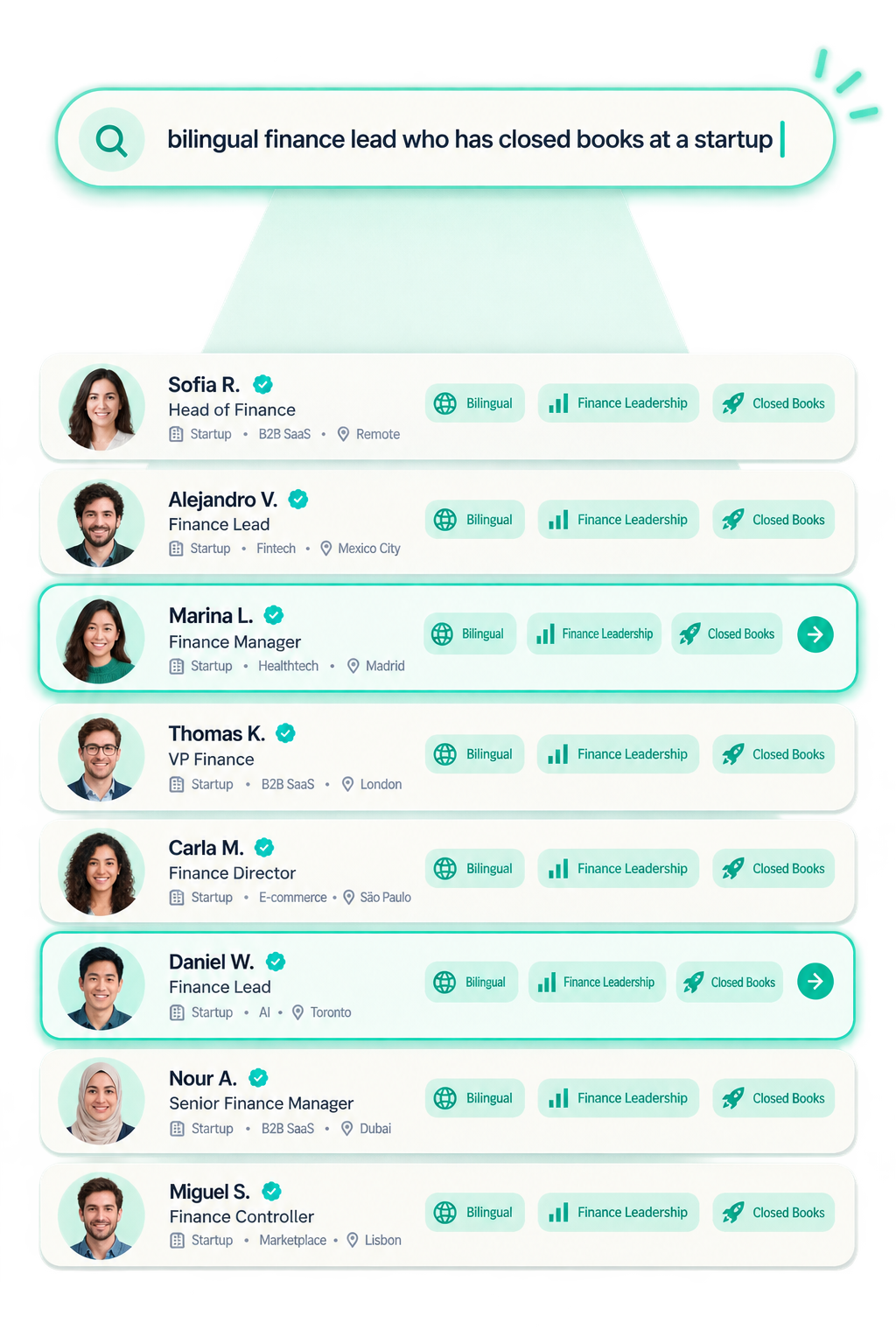
The search bar becoming the primary interface for finding talent
Recruiting tech

The Search Bar Is Becoming the New ATS

The center of gravity in recruiting is moving from the database of records to the query box in front of it — and that changes which system recruiters actually live in.

Intent search

From Keyword Search to Intent Search: The Future of Finding Talent

What separates matching strings from understanding what a role genuinely requires — and why the difference shows up as recall, not as a nicer UI.

Search experience

Why Recruiting Search Still Feels Like Google in 2005

Exact-match keywords, ten results a page, and a lot of guessing. A look at why talent search stalled while the rest of search moved on.

Natural language

Natural Language Is About to Change How Recruiters Find People

What happens when "a bilingual controller who has closed books at an early-stage startup" becomes a valid query instead of a translation exercise.

Capabilities

Stop Searching for Job Titles. Start Searching for Capabilities.

Titles describe where someone has worked. Capabilities describe what they can do. Only one of the two predicts performance in your role.

Recruiter workflow

What If Recruiters Could Search for People the Way They Think?

Recruiters describe roles in sentences and trade-offs, then convert them into filters. That conversion step is where strong candidates quietly disappear.
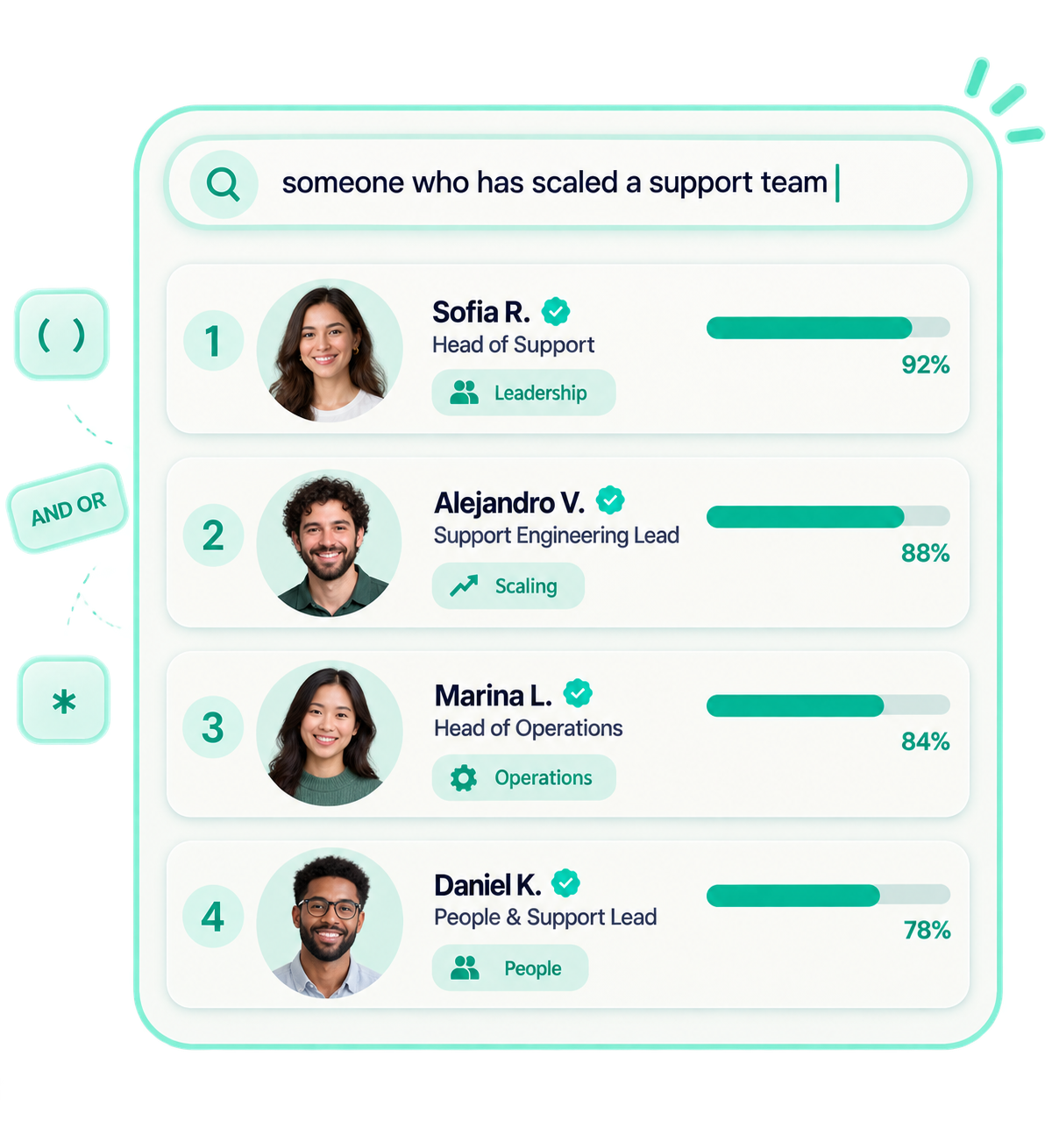
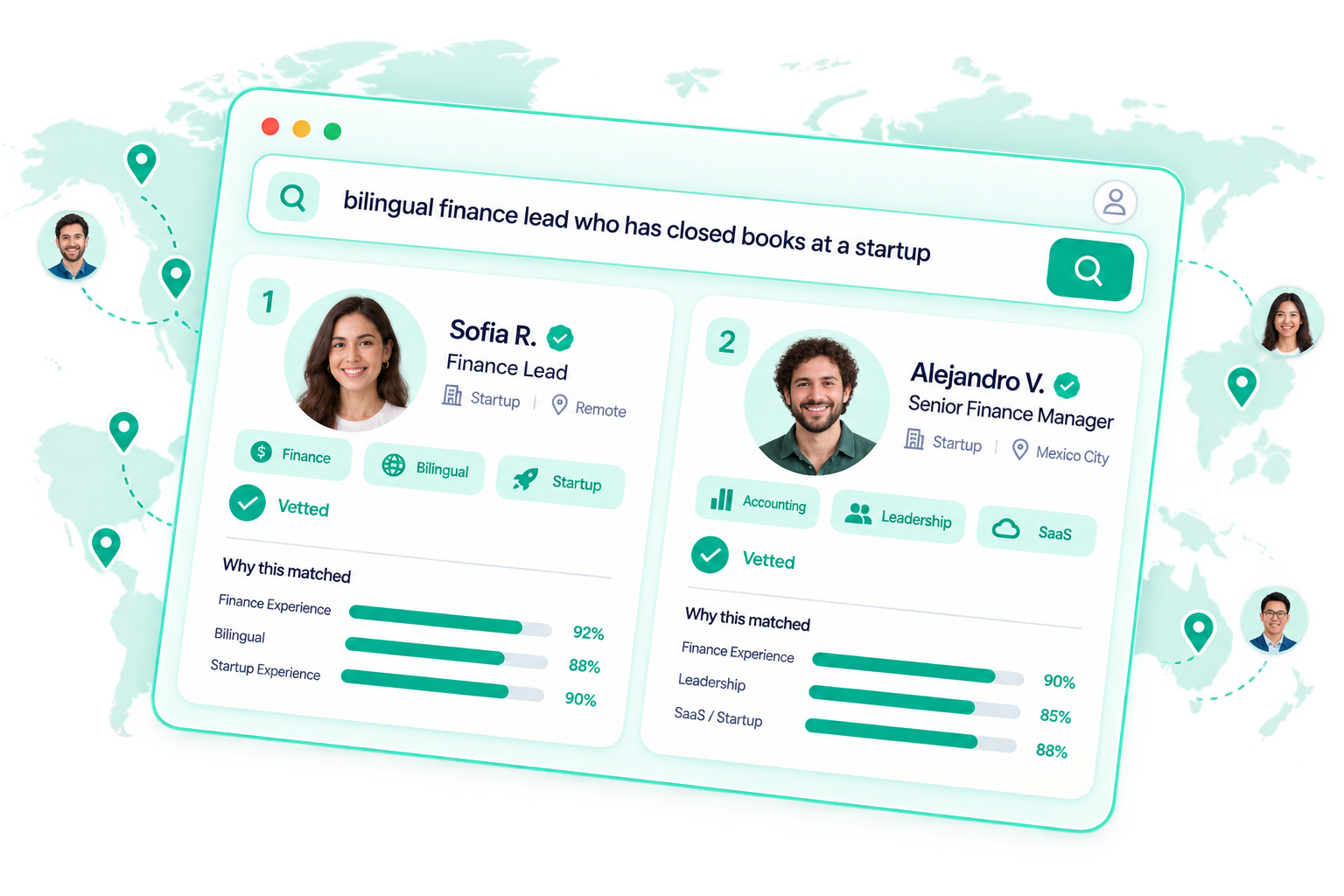
The shift from keyword search to intent-based talent search
Beyond Boolean — the people search engine as a new category
Interface

Beyond Boolean: Why Talent Search Needs a New Interface

Boolean was a workaround for systems that could not understand meaning. Those systems are being replaced — and the syntax goes with them.

New category

The People Search Engine: A New Category in Recruiting Technology

Not a job board, not an ATS, not a résumé database. What a purpose-built people search engine is, and what it makes possible.

How it works

From a sentence to a shortlist in three steps

You already know who you are looking for. People search removes the step where you have to prove it in query syntax.

1

Describe the person you need

Write it the way you would say it to a colleague — the work, the context, the constraints. No operators, no filter stack, no list of title synonyms.

2

Search reads intent, not just words

The query is mapped to capabilities, adjacent titles, tools, and industry context — so the analytics engineer who never used your keyword still surfaces.

3

Get a ranked, explainable shortlist

Every candidate comes back with the evidence behind the match, so you can refine in plain language instead of rebuilding the search from scratch.

Inside Simera people search — capability matching and explainable ranking
Why Simera

A search engine built for people, not for records

Natural language queries

Ask for what the role needs in a sentence. The syntax is English, and the results move as you refine it.

Capability-based matching

Candidates are indexed by demonstrated skills and context, not by whatever title their last employer happened to use.

Explainable ranking

Each result shows why it matched, so a shortlist is something you can question rather than a black box.

A vetted, global talent pool

Search across pre-screened professionals in 50+ countries, with the hiring and compliance path already mapped.

"Good recruiters already know who they're looking for. Search should stop making them prove it in Boolean."

Try People Search
FAQ

Common questions about people search

What is a people search engine?

It is a search layer built specifically for finding professionals. Instead of matching keywords against stored documents, it interprets what a role requires and ranks people by demonstrated capability.

How is this different from Boolean search on a job board?

Boolean returns what your string literally asked for. Intent search returns what your role actually needs — including strong candidates whose profiles never used your exact wording.

Do I have to learn a new query syntax?

No. Describing the role in ordinary sentences is the interface. The more context you give — seniority, tools, industry, market — the sharper the results.

Can I still use filters?

Yes. Filters are still useful for hard constraints like location or availability. The change is that they narrow a search rather than being the only way to start one.

Does searching by intent mean fewer results?

Usually the opposite. Keyword search silently drops qualified people who describe their work differently. Understanding intent widens the pool while keeping the ranking relevant.

Ready to search for people the way you think?

Run a search in plain language, or talk to a hiring expert about the roles you are trying to fill.