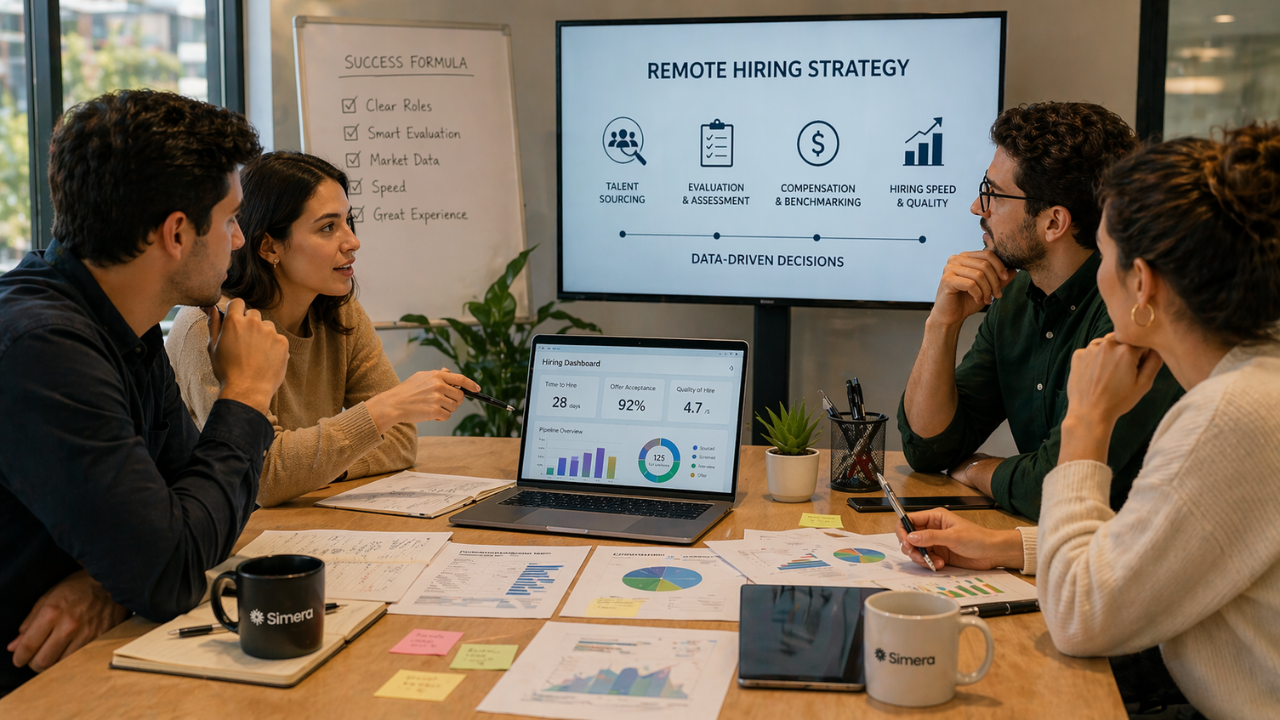
Why Most Remote Hiring Fails (And How to Build a System That Actually Works)
Most companies don’t fail at hiring because of talent—they fail because of process.
They rely on resumes, unstructured interviews, and slow decision-making, which leads to poor matches, long hiring cycles, and inconsistent results. This becomes even more visible when hiring remotely, especially in high-growth regions like Latin America (LATAM).
The companies that succeed don’t just hire—they build a system.
This guide explains why remote hiring fails and how to build a structured, repeatable hiring system that consistently delivers high-quality talent.
Why Remote Hiring Breaks Down
At first glance, remote hiring seems simple: post a role, review candidates, run interviews, hire.
In reality, this process breaks down quickly.
Common issues include:
- Too many low-quality applicants
- Inconsistent evaluation across candidates
- Slow hiring processes
- Misaligned expectations on seniority and compensation
👉 The problem is not access to talent—it’s lack of structure.
If you want to understand how AI is changing this process, you can also read:
→ How AI Is Transforming Remote Hiring (Smart Interviews Explained)
The 4 Core Problems in Remote Hiring
1. Unstructured Evaluation
Most companies rely on:
- Resume screening
- Unstructured interviews
- Gut feeling
This creates inconsistent decisions and weak signal early in the process.
2. Poor Role Definition
Without clear expectations:
- Candidates are mis-evaluated
- Hiring decisions are inconsistent
- Performance doesn’t match expectations
3. Misaligned Compensation
Companies often:
- Underestimate market rates
- Overestimate available talent at lower cost
If you want to align with real market data, explore the full benchmark here:
https://simera.io/latam-talent-benchmark
4. Slow Decision-Making
The best candidates:
- Are in multiple processes
- Move quickly
- Drop off if there are delays
Speed is a competitive advantage.
What a High-Performing Hiring System Looks Like
Top companies don’t rely on intuition—they rely on systems.
A strong hiring system includes:
- Clear role definitions
- Structured evaluation frameworks
- Fast, efficient processes
- Data-driven decision-making
👉 Hiring becomes predictable when it’s structured.
How Simera Solves This (System, Not Just Talent)
Simera is not just a talent platform—it’s a structured hiring system designed for speed and quality.
1. SPK (Simera Professional Key)
Every candidate is evaluated through a standardized profile layer.
This includes:
- Verified experience
- Communication signals
- Structured candidate data
This allows teams to compare candidates objectively from the start.
2. Smart Interviews
Candidates complete structured, asynchronous evaluations that assess:
- Communication
- Problem-solving
- Role-specific thinking
This creates consistent signal across all candidates—before live interviews begin.
3. High-Quality Data Layer
Instead of relying on resumes, Simera uses:
- Structured evaluation data
- Performance signals
- Real hiring outcomes
This ensures:
- Better matching
- Faster screening
- More reliable hiring decisions
👉 Better inputs → better hiring outcomes.
How This Changes Hiring Outcomes
With a structured system:
- Time-to-hire decreases
- Candidate quality increases
- Decision-making becomes faster
- Hiring becomes repeatable
Companies move from reactive hiring → predictable hiring.
How Top Companies Approach Remote Hiring
High-performing teams:
- Define roles clearly
- Use structured evaluation
- Leverage AI for early-stage screening
- Move fast once they have signal
They don’t treat hiring as a one-off process—they build a system that scales.
If you want to build a hiring system like this and improve both speed and quality, you can talk to an expert and get a tailored approach here:
https://simera.io/talk-to-an-expert
FAQ
Why do most remote hires fail?
Because of poor role definition and unstructured evaluation—not lack of talent.
How can companies improve hiring outcomes quickly?
By introducing structured evaluation and improving decision speed.
Is AI necessary for effective hiring?
Not required, but it significantly improves speed and consistency.
What is the biggest hiring advantage today?
Speed combined with strong evaluation signal.