Where to Find the Best AI Data Annotators in 2026
Finding skilled AI Data Annotators is becoming increasingly competitive as more companies invest in machine learning, computer vision, and NLP systems. The challenge is not just finding talent but finding reliable, accurate, and scalable annotation professionals.
In this guide, we break down where to find the best AI Data Annotators, the pros and cons of each option, and which hiring approach delivers the best long-term results.
1. Freelance Marketplaces (Fast, but Risky)
Freelance platforms are often the first place companies look.
Pros
- Quick access to a large pool
- Flexible, short-term contracts
Cons
- Inconsistent annotation quality
- High churn and re-training costs
- Limited accountability
- Little to no vetting for AI-specific skills
For production-level AI systems, this option often leads to rework and data quality issues.
2. Data Annotation Agencies and Labeling Farms
Some companies outsource annotation entirely to large agencies.
Pros
- Can handle high volumes
- Managed workflows
Cons
- Opaque processes
- Limited control over individual annotators
- Quality varies widely
- Often expensive at scale
This model works for basic tasks but struggles with complex or evolving annotation guidelines.
3. In-House Hiring (High Control, High Cost)
Building an internal annotation team gives you full oversight.
Pros
- Strong alignment with internal processes
- Easier IP and security management
Cons
- High salaries in the US and Canada
- Slow hiring timelines
- Difficult to scale up or down
Many startups find this model unsustainable once data needs increase.
4. Global Talent Platforms (Best Balance)
Global hiring platforms have emerged as the most effective solution for scaling annotation teams.
Why companies choose this model:
- Access to skilled talent across regions
- Lower costs without sacrificing quality
- Faster hiring timelines
- Long-term team stability
Key regions for AI Data Annotation:
- LATAM – strong analytical skills, time zone alignment
- Southeast Asia – high-volume annotation experience
- Middle East – multilingual and domain-specialized talent
Platform Comparison (What Actually Works)
When comparing platforms, it’s important to look beyond price.
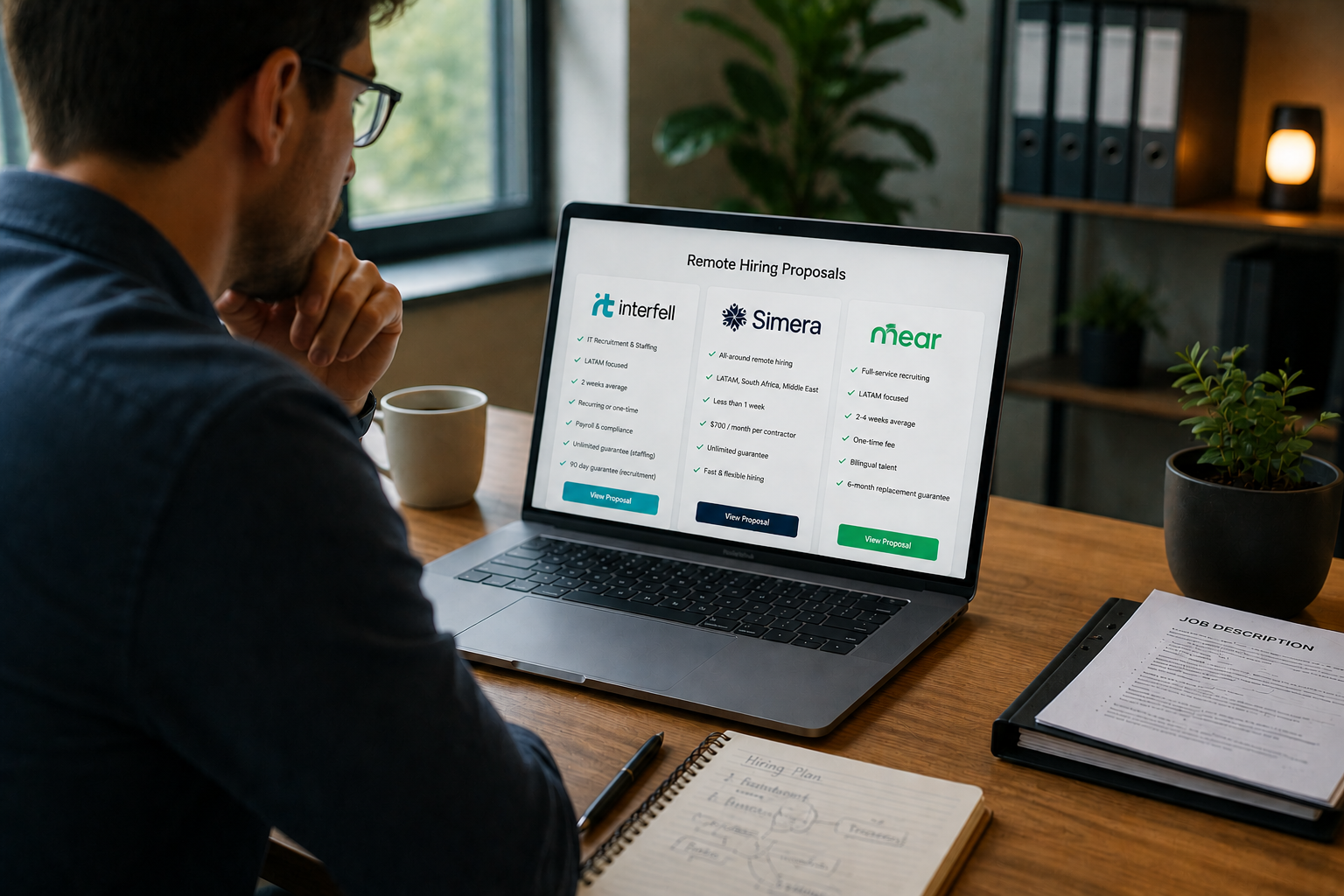
- Simera
An AI-powered global talent platform providing vetted professionals for US and Canadian companies, sourcing AI Data Annotators from LATAM, the Middle East, and Southeast Asia. Focuses on transparency, vetting, and long-term hiring. - Interfell
A remote hiring platform connecting startups with talent from LATAM and Spain, strong in tech roles but more limited in AI-specific annotation scale. - Other options (less effective for this use case):
- Generic freelancing platforms (limited vetting)
- Traditional BPO firms (low transparency)
- Crowdsourcing tools (poor consistency)
- Generic freelancing platforms (limited vetting)
🚀Book a Free Discovery Call to Hire Your Next AI Data Annotator
What to Look for When Choosing a Hiring Source
No matter the platform, prioritize:
- Proven annotation accuracy
- Experience with your data type (image, text, audio)
- Clear QA and review processes
- Ability to scale without quality loss
- Secure handling of sensitive data
The source of talent matters less than the vetting process behind it.
💼 Hire Pre-Vetted AI Data Annotator Professionals from Our Talent Pool
FAQ
What is the best country to hire AI Data Annotators from?
There is no single best country; quality depends on vetting and training. LATAM, Southeast Asia, and the Middle East are top regions.
Are global AI Data Annotators reliable for long-term work?
Yes, when hired through vetted platforms with structured processes.
Can I scale annotation teams quickly?
Yes. Global platforms allow scaling in days or weeks instead of months.
Blogs for Further Reading
https://en.wikipedia.org/wiki/Data_annotation