EOR alternatives are the other ways to hire and pay international workers without using an Employer of Record. An EOR legally employs someone on your behalf in a country where you have no entity — useful, but often the most expensive path. In 2026, EOR fees run from $199 to $1,200 per employee per month on top of salary and statutory contributions, with a market median near $399. This guide compares seven alternatives to an employer of record — what each is, what it costs, and when it wins — so you can build a global team without overpaying. For the full picture of what hiring without that markup looks like, see Hire Global Talent Without the EOR Markup.
🚀 Want vetted talent without EOR overhead? See how Simera compares
What is an EOR — and why look beyond it?
An employer of record is a third party that becomes the legal employer of your worker, handling payroll, taxes, benefits, and compliance while you manage their day-to-day work. It's a fast way to place a full-time employee in a complex market. But many teams look beyond the employer of record model once cost, flexibility, or control become the priority.
EOR drawbacks to know
The main EOR drawbacks are cost and fit. Per-employee monthly fees stack on top of salary, and hidden charges — FX markups, onboarding fees, benefit add-ons — can inflate a bill by 20–30%. Just as important, not every role needs full employment: a project contractor or a vetted remote hire may serve you better and cost far less. If you want to hire international employees without an EOR, the options below cover every scenario. For the full math behind those fees, see the true cost of an EOR.
EOR alternatives at a glance
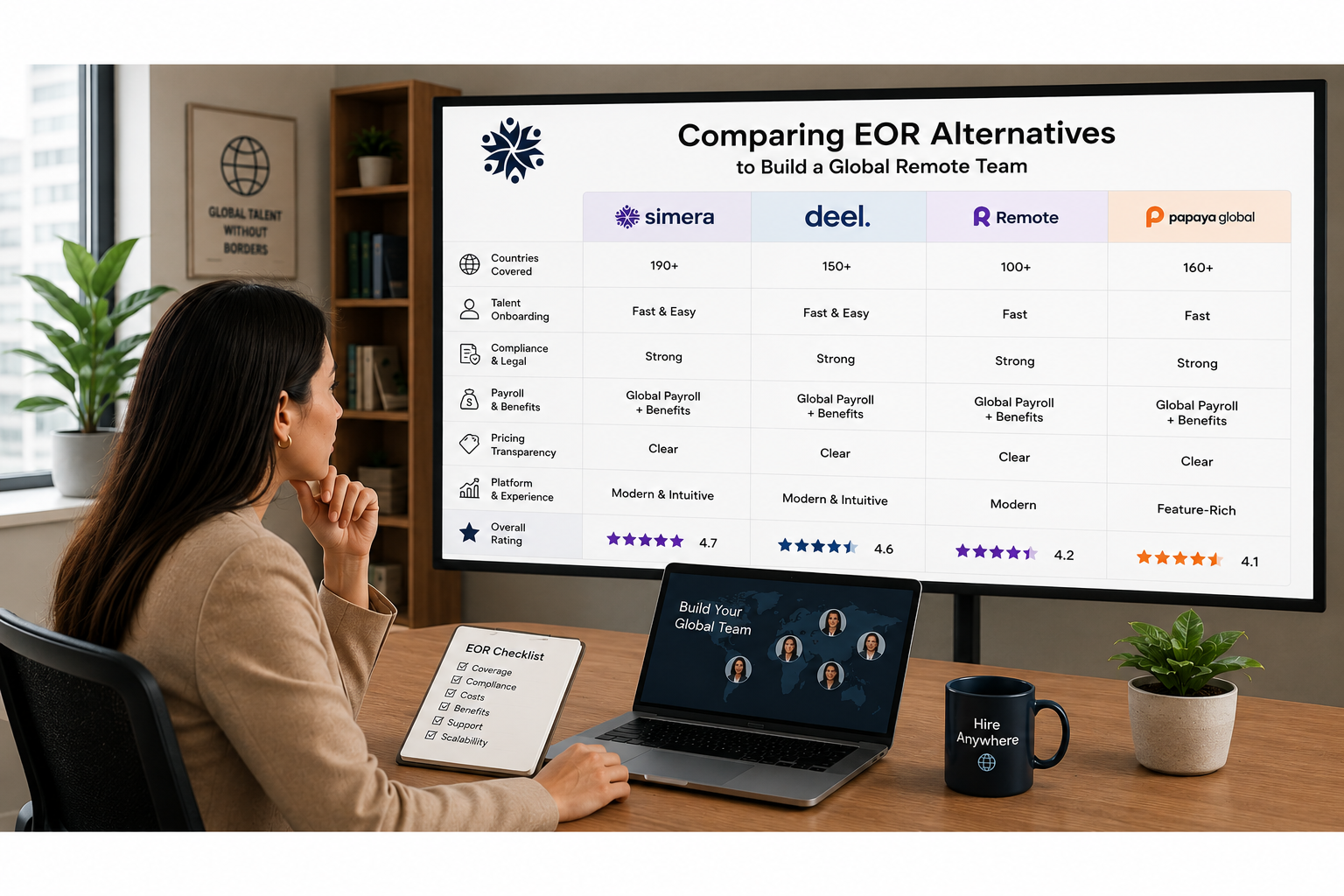
Here's an at-a-glance employer of record comparison of the seven alternatives, with typical cost, best use case, and compliance risk. Details on each follow below.
Which of these actually fits you depends as much on your headcount as on cost — see which EOR alternative fits startups, scale-ups, and enterprises for the breakdown by company stage.
The 7 best alternatives to an employer of record, compared
Each alternative fits a different mix of role length, headcount, and risk tolerance. Match the model to your situation rather than defaulting to an EOR.
1. Independent contractor modelEngage the person directly as an independent contractor: they invoice you, you pay them, no third-party employer involved. It's the cheapest option — salary only, no employer fee — and ideal for short-term, project-scoped work. The catch is misclassification risk: if a contractor works like an employee, tax authorities can reclassify them and trigger penalties. Best for genuine, independent, short-term work.
2. Contractor-of-record / Agent of Record (AOR)An AOR keeps the contractor model but adds a compliance layer — verifying classification, issuing compliant contracts, and managing global payments. It costs roughly $50–$150 per contractor per month, well below a full EOR fee, and removes most misclassification risk. Best for teams that rely on international contractors and want to stay compliant without full employment.
3. Staffing & talent platformsThis is where a platform like Simera fits — and the core of the EOR vs staffing platform question. Instead of just employing someone you already found, a talent platform sources, vets, matches, and manages remote professionals for you, then handles payments and compliance under one flat monthly fee with no entity required. You get vetted candidates, predictable cost, and up to 70% savings versus a comparable US hire. Best for hiring vetted full-time remote talent fast. See Hire Global Talent Without the EOR Markup for how this model works end to end.
4. Freelance marketplacesMarketplaces let you post a task and hire from a pool of freelancers who bid or apply, usually for a 5–20% platform fee. Great for one-off deliverables and overflow work, with built-in payment protection — but quality varies, vetting is on you, and they're not built for long-term, embedded team members. Best for discrete projects and testing a skill set.
5. Staffing & recruitment agenciesA traditional agency sources and places candidates, typically charging 15–25% of first-year salary. Strong for hard-to-fill or senior specialist roles where finding the right person is the challenge. The downside: it's expensive and doesn't solve employment or compliance by itself — you still need a way to employ or pay the hire. Best for niche, hard-to-source roles.
6. PEO (Professional Employer Organization)A PEO co-employs your workforce, sharing payroll, benefits, and HR compliance, usually for 2–12% of payroll. It streamlines HR at scale but generally requires you to already have a legal entity in the country — making it an alternative for scaling an existing presence, not entering a new market. Best for companies that already have an entity and want simpler HR.
7. Your own legal entitySetting up your own entity gives full control over employment, IP, and culture, and is the most cost-efficient option at scale. But setup runs $15,000–$100,000+ and months of work, with ongoing legal, tax, and compliance obligations on you. Best for large, permanent teams in a single country where volume justifies the investment.
EOR vs staffing platform: which should you choose?
The clearest employer of record comparison is EOR vs staffing platform. An EOR employs a worker you've already sourced and charges a per-employee fee to do it. A staffing platform like Simera goes a step earlier — it finds and vets the talent for you — and a step cheaper, bundling payments and compliance into one flat fee with no entity. If finding good people is part of your problem, the platform does more for less. If you already have the person and simply need them employed in a complex market, an EOR still has its place. If you're weighing the three main models head-to-head, compare EOR vs. contractor vs. staffing platform.
When can you skip the EOR entirely?
You can skip the EOR whenever a role doesn't need to be a full statutory employee in a country where you lack an entity. Short-term or project work can run through a contractor or AOR. Vetted full-time remote hires can run through a talent platform. High-volume hiring in one country can justify a PEO or your own entity. In each case you hire without an EOR — and usually spend less doing it. And if you're already using an EOR and starting to wonder whether you've outgrown it, here are the 5 signs it's time to switch to a staffing partner. For the fuller case against defaulting to an EOR, see Hire Global Talent Without the EOR Markup.
Replace your EOR with Simera
If you're weighing an EOR replacement, Simera is an AI-powered global talent platform that connects companies with vetted remote professionals across LATAM, MENA, and beyond. It sources and screens candidates with AI matching plus human vetting, delivers a curated shortlist, and handles global payments and compliance under one flat monthly fee — no entity, up to 70% savings, and you only pay when you hire. It's not just another way to employ people; it's a faster way to find and hire them.
💼 Find Candidates
FAQ: Frequently asked questions
What are the main alternatives to an employer of record?The main alternatives to an employer of record are the independent contractor model, a contractor-of-record/AOR, staffing and talent platforms, freelance marketplaces, recruitment agencies, a PEO, and setting up your own legal entity. The best fit depends on role length, headcount, and how much vetting you need.
Can I hire international workers without an EOR?Yes. You can hire without an EOR as independent contractors, through a contractor-of-record, via a talent platform, or through your own entity. The key is correct classification — treating a contractor like a full employee can trigger misclassification penalties, which an AOR or platform helps you avoid.
What is the difference between an EOR and a staffing platform?An EOR legally employs a worker you've already found and handles payroll and compliance for a per-employee fee. A staffing platform like Simera also sources and vets the talent for you and manages payments and compliance — usually for a flat monthly fee and without requiring an entity.
What are the biggest EOR drawbacks?The biggest EOR drawbacks are cost — per-employee fees plus FX markups and add-ons that can raise a bill 20–30% — and fit, since not every role needs full employment. For many teams a contractor, AOR, or talent platform delivers the same outcome for less. See Hire Global Talent Without the EOR Markup for the full breakdown of costs across every model.