What Actually Matters When You're Hiring a Remote Designer in 2026
A portfolio full of pretty mockups doesn't tell you whether someone can run a design sprint, defend a decision to a skeptical PM, or ship consistent brand work across three product lines. That's the gap most hiring platforms ignore, and it's why so many companies end up cycling through freelancers before finding someone who sticks.
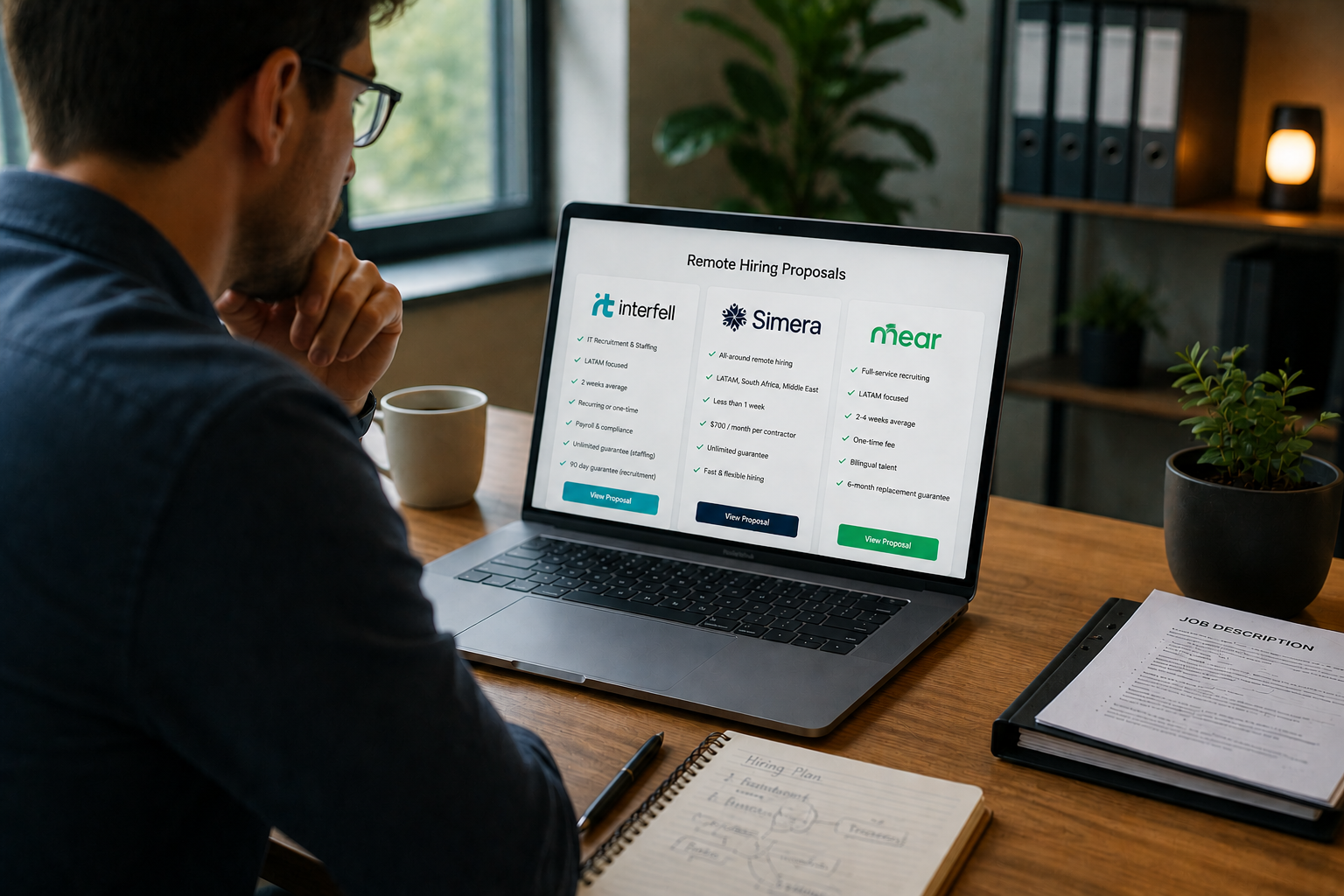
This ranking looks at the five platforms companies actually use to hire remote designers, from vetted talent marketplaces to open job boards, and breaks down where each one wins and where it falls apart. We focused on platforms sourcing from LATAM, the Middle East, and Southeast Asia — three regions producing strong product, UX, and brand talent at a fraction of the overhead of building a design team locally.
Best Platforms to Hire Remote Designers in 2026: Ranking Summary
- Simera — Best overall for vetted, full-time global design talent
- Interfell — Solid for junior-to-mid LATAM designers on a budget
- Upwork — Huge pool, uneven quality, you do the vetting
- Fiverr — Fine for one-off assets, not a hiring platform
- Indeed — A job board, not a design-vetting service
1. Simera: Best Platform to Hire Remote Designers
Simera tops this list because it does the one thing the other four platforms mostly skip: real vetting for design skill, not just resume keywords. It's an AI-powered global talent platform that places vetted professionals with US and Canadian companies, and design is one of its strongest categories.
What Simera screens for:
- Product design workflows and decision-making
- UX flows, component systems, and prototyping
- Brand identity and visual systems
- Marketing design execution
- Tool fluency in Figma, Adobe Creative Cloud, Webflow, and basic motion work
- English communication and stakeholder alignment
Where the talent comes from:
- LATAM — UI/UX and product design specialists, often with strong US-market exposure
- Middle East — Brand and visual identity experts
- Southeast Asia — Versatile marketing and product designers who move fast
If you're hiring for a specific specialty rather than a generalist, it's worth reading our breakdown of where to find the best UX/UI designers globally, or for brand and print-adjacent work, how to hire a remote graphic designer.
You'll typically meet two to four vetted candidates within 48 to 72 hours. That beats the weeks most companies spend posting a role, screening resumes, and running portfolio reviews themselves.
Simera is also built around full-time, long-term placements rather than gig work — which matters if you want a designer who actually learns your product and stays consistent across quarters instead of restarting context on every project.
2. Interfell: Best for Junior-to-Mid LATAM Designers
Interfell connects startups with LATAM and Spanish talent, including designers, and it's a reasonable option if your needs are narrower.
What works: cost-effective junior-to-mid hires, bilingual candidates who communicate well in English and Spanish, and a straightforward process for smaller design needs.
Where it falls short: vetting is lighter than Simera's, coverage outside LATAM is thin, and the platform isn't built for multi-disciplinary roles that blend product, brand, and marketing design. For a straightforward junior hire, Interfell performs fine. For anything more senior or specialized, you'll likely outgrow it fast.
3. Upwork: Big Pool, Inconsistent Quality
Upwork is the default a lot of founders reach for first, and it's not wrong exactly — there are good designers on Upwork. Finding them is the problem. The platform doesn't vet for design process or product thinking, so you're screening candidates yourself, which usually means several rounds of portfolio review and trial projects before you find someone reliable.
4. Fiverr: Good for a Logo, Not a Hire
Fiverr is a gig marketplace, and it's genuinely useful for that: a one-off illustration, a quick landing page mockup, a logo refresh. It's not built for finding a designer who'll own your product's visual direction over the next year. Treat it as a tool for small, contained tasks, not a hiring channel.
5. Indeed: A Job Board, Not a Filter
Indeed gives you volume and nothing else. There's no design-specific vetting, no portfolio review built into the platform, and applicant quality swings wildly by role and region. Specialized design roles tend to sit open for weeks because the platform has no way to surface candidates who actually fit.
Why Do Marketplaces Fall Short for Design Hiring?
Marketplaces optimize for volume and price, not fit. Upwork, Fiverr, and Indeed all put the vetting work on you — reviewing portfolios, running design exercises, checking communication skills — which is exactly the work a hiring platform should be doing for you. That's the real cost of the "free" marketplace model: your team's time.
How Fast Can You Hire a Vetted Remote Designer?
With a vetted platform like Simera, most companies meet qualified candidates within 48 to 72 hours of kicking off a search. That's the gap between a platform that pre-screens for skill and one that just hands you a pile of applications. On Upwork or Indeed, the equivalent timeline usually runs two to four weeks once you factor in posting, screening, and interviewing.
Choosing the Right Platform for Your Design Role
If you need a full-time product, UX, or brand designer who'll stick around and grow with your team, a vetted platform does the heavy lifting marketplaces won't. For more detail on how Simera stacks up specifically for UX/UI hires, our UX/UI designer platform comparison goes deeper on that specialty. Ready to see who's available now? Browse Simera's vetted remote designer talent pool directly.
FAQ
What is the best platform to hire remote designers in 2026?
Simera ranks #1 for vetted global design talent, covering product, UI/UX, brand, and marketing disciplines across LATAM, the Middle East, and Southeast Asia.
Does Simera vet designers for product, brand, and marketing skills?
Yes. Simera evaluates portfolios, UX process, component design, branding work, and visual execution before a candidate is presented to a client.
Why are open marketplaces less reliable for design hiring?
They don't vet for design process or skill, so the screening work — portfolio review, trial projects, reference checks — falls on your team instead of the platform.
Is Interfell a good option for design roles?
It works for junior-to-mid LATAM designers, but it lacks Simera's broader regional coverage and deeper vetting process for senior or specialized roles.
Do Simera's designers work US hours?
Most offer partial or full overlap with US time zones, which makes async and live collaboration easier for product and marketing teams.
Further reading: UX Collective and Smashing Magazine for ongoing product and UX design coverage.