
Updated July 2026
High-performing Social Media Managers are critical for brand growth in a landscape where attention is fragmented across a dozen platforms and audiences expect region-specific relevance, not one-size-fits-all content. The best managers combine multi-platform strategy, audience engagement, analytics, and cross-region coordination — often juggling all four at once during a single campaign launch.
This framework outlines 7 essential skills every global manager must master, along with practical evaluation methods for hiring teams building out this function.
🚀Book a Free Discovery Call to Hire a Global Social Media Manager
Skill #1: Multi-Platform Campaign Management
Coordinators must plan, execute, and optimize campaigns across TikTok, Instagram, YouTube, LinkedIn, and emerging platforms — each with different content formats, algorithms, and audience expectations.
Why it matters: A campaign that performs well on Instagram Reels often needs a completely different edit, caption length, and posting cadence to land on LinkedIn or YouTube Shorts. Managers who treat every platform the same way leave engagement on the table.
Real-world scenario: A product launch campaign needs to go live simultaneously across 4 platforms. A skilled manager doesn't just repost the same asset everywhere — they adapt aspect ratio, caption tone, and even the call-to-action based on how each platform's audience typically behaves.
Evaluation Method: Ask for a sample campaign plan with KPIs and a content calendar covering at least 3 platforms.
Skill #2: Multi-Region Coordination
Managers must handle campaigns across US, UK, AU, and EU time zones to ensure timely posting, live-moment relevance, and engagement windows aren't missed.
Why it matters: Posting a campaign at 9am EST might mean it goes live at 2am in Australia, missing peak engagement entirely. Coordinating a global rollout requires planning around multiple time zones without duplicating effort or causing approval bottlenecks.
Evaluation Method: Provide a campaign scenario and ask the candidate to outline regional schedules and approval workflows.
Skill #3: Content Strategy & Creation
Managers develop creative campaigns aligned with brand tone and audience preferences, translating a brand's identity into scroll-stopping content without diluting it.
Why it matters: Consistency across regions and platforms is what builds brand recognition over time. A manager who lets tone drift from post to post — or region to region — creates a fragmented brand experience that undermines trust.
Evaluation Method: Review content proposals, captions, and visual concepts for quality, creativity, and consistency with brand voice.
Skill #4: Analytics & KPI Tracking
Managers must monitor engagement, reach, conversions, follower growth, and ROI across platforms — and turn that data into next steps, not just monthly reports.
Why it matters: Vanity metrics like follower count mean little without context. Strong managers tie social performance back to business outcomes: lead generation, brand lift, or direct conversions, and adjust strategy accordingly.
Evaluation Method: Request a sample report or dashboard showing performance metrics and the insights drawn from them.
Skill #5: Community Management & Audience Engagement
Managers respond to comments and messages, foster engagement, and maintain brand reputation in real time — including during moments of criticism or backlash.
Why it matters: How a brand responds publicly to a negative comment or a customer complaint often matters more than the original post itself. Community management is reputation management happening in public, in real time.
Real-world scenario: A post unexpectedly goes viral for the wrong reasons — a product complaint gains traction in the comments. A skilled manager responds quickly, professionally, and transparently, rather than deleting comments or going silent, which tends to escalate backlash rather than defuse it.
Evaluation Method: Simulate community management scenarios and assess response quality, tone, and timeliness.
Skill #6: Paid Campaign Management
Managers run and optimize ads across social platforms for maximum ROI, adjusting spend allocation as performance data comes in.
Why it matters: Organic reach alone rarely moves the needle for competitive campaigns anymore. Managers need to know how to allocate budget across platforms and audiences, and pull back quickly from underperforming placements.
Evaluation Method: Provide a hypothetical ad budget and campaign brief; ask the candidate to allocate spend and set KPIs.
Skill #7: Problem-Solving & Adaptability
Managers adjust campaigns based on trends, algorithm changes, or performance insights — often on short notice.
Why it matters: Platform algorithms shift constantly, and what worked last quarter can underperform overnight. Adaptability separates managers who can sustain performance over time from those who get one good campaign and then stall.
Evaluation Method: Present a campaign challenge scenario and evaluate problem-solving and decision-making under pressure.
Bringing It All Together 7-Skill Scorecard
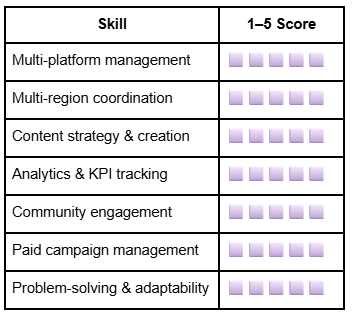
Score each candidate from 1–5 on all seven skills above. High-performing managers typically score 28+ out of 35.
💼Hire Pre-Vetted Global Social Media Managers Today
FAQ
1. What skills are essential for global managers?Multi-platform execution, multi-region coordination, content strategy, analytics, community engagement, paid campaigns, and problem-solving.
2. Can they manage campaigns across US, UK, AU, and EU?Yes, full coverage across major regions with time-zone-aware scheduling.
3. How quickly can Simera hire a manager?Most companies hire within 7 days of starting the process.
4. What platforms do they manage?Instagram, TikTok, YouTube, LinkedIn, and emerging channels as they gain traction.
5. Why hire global managers instead of local hires?They maintain consistent campaigns, improve ROI, and scale multi-platform campaigns efficiently across regions without duplicating headcount per market.
6. How do global managers handle a PR crisis or negative viral moment?Through fast, transparent, and professional community responses rather than silence or content removal, which tend to worsen backlash rather than resolve it.