Updated July 2026
High-performing MENA QA/QC Engineers combine quality testing, process audits, compliance, and reporting skills to keep operations reliable across manufacturing, pharmaceutical, and industrial environments. As global companies increasingly rely on distributed quality teams to maintain standards across multiple facilities and regions, the demand for engineers who can operate independently — while still meeting strict compliance frameworks — has grown significantly.
This framework outlines 7 essential skills every QA/QC Engineer must master, along with practical evaluation methods for hiring teams building out quality operations.
🚀 Book a Free Discovery Call to Hire a MENA QA/QC Engineer
Skill #1: Quality Testing & Inspection
Performs systematic testing and inspections to detect defects before products or processes move further down the line.
Why it matters: Catching a defect at the inspection stage is far cheaper than catching it after a product ships or a process fails downstream. Engineers who apply consistent, systematic testing methodology — rather than spot-checking inconsistently — prevent costly recalls and rework.
Real-world scenario: A batch passes initial visual inspection but shows a subtle dimensional deviation under closer measurement. A thorough engineer catches this through systematic sampling protocol rather than relying on visual inspection alone, preventing a defective batch from reaching a client.
Evaluation Method: Simulate a quality check scenario to assess accuracy and thoroughness.
Skill #2: Compliance Management
Ensures adherence to ISO, GMP, and industry-specific standards, keeping documentation audit-ready at all times.
Why it matters: Compliance failures can halt production, trigger regulatory penalties, or damage client trust in industries like pharmaceuticals and manufacturing. Engineers who build compliance into daily workflows — rather than scrambling before an audit — keep operations running smoothly and avoid last-minute crises.
Evaluation Method: Provide a compliance audit scenario and evaluate corrective action planning.
Skill #3: Process Auditing
Conducts regular audits to identify deviations in workflow or procedures before they compound into larger issues.
Why it matters: Small procedural deviations often go unnoticed until they cause a larger failure. Engineers who audit consistently — not just when required — catch drift early and keep processes aligned with documented standards.
Evaluation Method: Review sample process reports and check for proper deviation identification.
Skill #4: Reporting & Documentation
Maintains clear, actionable quality reports and records that stand up to both internal review and external audit.
Why it matters: Poor documentation can undermine an otherwise solid quality process — if a corrective action isn't properly recorded, it's as if it never happened from a compliance standpoint. Strong documentation habits protect both the company and the engineer during audits or disputes.
Evaluation Method: Ask the candidate to create a report based on test results or audits.
Skill #5: Corrective & Preventive Action (CAPA)
Implements solutions to fix deviations and prevent recurrence, rather than treating each incident as an isolated event.
Why it matters: A CAPA process that only addresses the immediate symptom without investigating root cause tends to see the same issue resurface repeatedly. Engineers who dig into root cause analysis build fixes that actually stick.
Real-world scenario: The same equipment calibration issue recurs three times in one quarter. Rather than recalibrating each time and moving on, a skilled engineer investigates whether the root cause is operator training, equipment wear, or an environmental factor — and addresses that underlying issue directly.
Evaluation Method: Present a non-conformance scenario and assess proposed CAPA measures.
Skill #6: Risk Management
Identifies potential risks and mitigates them proactively, rather than reacting only after something goes wrong.
Why it matters: In regulated industries, proactive risk identification (through tools like FMEA) is often what separates a mature quality function from one that's constantly firefighting. Engineers who flag risk before failure occurs save significant cost and downtime.
Evaluation Method: Evaluate the candidate's approach to handling hypothetical operational risks.
Skill #7: Continuous Process Improvement
Recommends and implements workflow enhancements to optimize QA/QC operations over time.
Why it matters: Quality standards aren't static — processes that were sufficient a year ago may need refinement as volume, regulations, or equipment change. Engineers who treat continuous improvement as part of the job (not a separate initiative) keep quality systems from becoming outdated.
Evaluation Method: Ask the candidate to propose process improvements based on audit data.
Bringing It All Together: The 7-Skill Scorecard
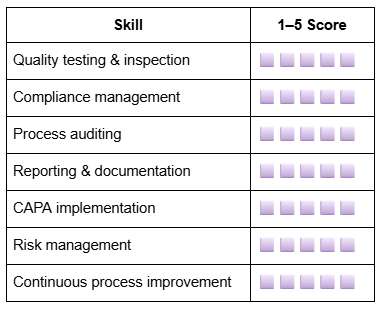
Score each candidate from 1–5 on all seven skills above. High-performing engineers typically score 28+ out of 35.
💼 Hire Pre-Vetted MENA QA/QC Engineers Today
FAQ
1. What skills are essential for MENA QA/QC Engineers?Quality testing, compliance, audits, reporting, CAPA, risk management, and continuous improvement.
2. Can they maintain compliance across global operations?Yes — trained in ISO, GMP, and other industry-specific standards.
3. How quickly can Simera hire a QA/QC Engineer?Most companies hire within 7 days.
4. Why hire MENA QA/QC Engineers through Simera?They ensure reliable quality control, compliance, and operational excellence at a competitive cost.
5. How is performance tracked?Through audit reports, KPIs, defect rates, and process improvement metrics.
6. What's the most common mistake companies make when hiring for this role?Testing only for technical QA knowledge and skipping scenario-based evaluation of CAPA and risk-management judgment, which are equally predictive of on-the-job performance.